What We Do

Foundry Services & Capabilities

Full-spectrum MEMS fabrication from mask design through finished device, with specialized expertise in silicon carbide (SiC) for harsh-environment applications. Prototype through production volumes.

01

Mask Layout

Every MEMS device begins with a photomask. Our mask layout team designs and prepares high-precision photomasks for semiconductor fabrication, translating complex device architectures into production-ready patterns with nanometer-level accuracy.

We support pattern generation for intricate MEMS geometries including cantilevers, membranes, interdigitated electrodes, and microfluidic channels. Our multi-layer design capability ensures precise registration between process layers, critical for devices requiring tight overlay tolerances.

From single-layer prototypes to complex multi-mask sets with dozens of layers, our design process accounts for process biases, etch compensation, and alignment mark placement to maximize fabrication yield.

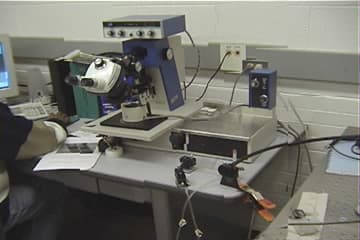
Photomask design workstation at Biotronics01 / Mask Layout
02

Photolithography

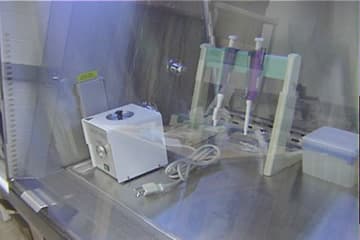
Photolithography is the cornerstone of semiconductor fabrication. Our advanced light exposure systems transfer mask patterns onto photoresist-coated substrates with critical dimension control extending to sub-micron feature sizes.

We maintain rigorous process control over resist coating uniformity, exposure dose, focus, and development parameters. Our alignment systems achieve the accuracy required for multi-layer processes, ensuring each subsequent pattern layer registers precisely to previous layers.

Our lithography capability supports a range of resist chemistries and exposure wavelengths, enabling us to optimize processes for different substrate materials including silicon, silicon carbide, and aluminum nitride. We work with both positive and negative tone resists for maximum process flexibility.

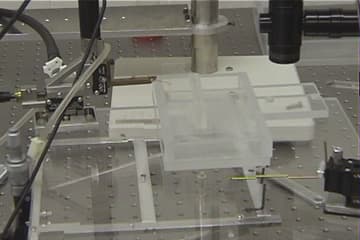
Photolithography exposure system02 / Photolithography
03

Electroplating

Electroplating enables the formation of thick metal structures essential for many MEMS devices. We deposit gold, nickel, copper, and specialty metals with precise control over thickness, uniformity, and microstructure.

Our plating processes are optimized for MEMS-specific requirements: high aspect ratio structure formation, stress-controlled deposits for freestanding microstructures, and conformal coverage over complex topographies. Tight current density control and bath chemistry management ensure reproducible results wafer to wafer.

Applications range from interconnect metallization and contact pads to structural elements such as proof masses, springs, and microactuator components. We tailor plating parameters to meet the mechanical, electrical, and thermal requirements of each specific device application.

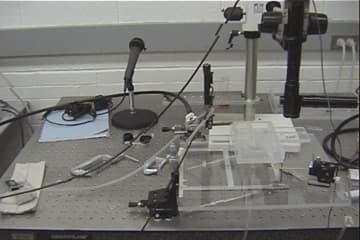
Electroplating bath for MEMS metal deposition03 / Electroplating
04

Chemical Mechanical Polishing (CMP)

Chemical mechanical polishing is essential for multi-layer MEMS fabrication, providing the planar surfaces required for subsequent lithography and deposition steps. Our CMP processes deliver both global and local planarization across the entire wafer surface.

We control surface roughness to nanometer precision, critical for devices where surface quality directly impacts performance — including optical MEMS, RF switches, and pressure sensors. Our process recipes are tuned for each substrate material and layer composition.

CMP enables the fabrication of complex 3D MEMS architectures by allowing multiple structural layers to be built up with the planarity required for high-resolution patterning at each level. This capability is fundamental to our multi-layer device fabrication process.

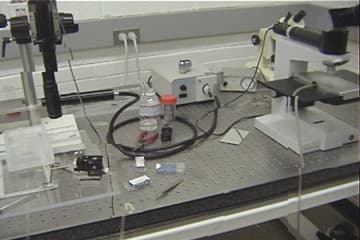
CMP wafer planarization equipment04 / Chemical Mechanical Polishing (CMP)
05

MEMS Fabrication

Our complete MEMS fabrication capability integrates all process steps into cohesive device manufacturing flows. We build microelectromechanical systems that combine mechanical, electrical, and thermal elements on a single substrate.

Each fabrication process is custom-developed for the specific application, whether it demands high-temperature operation on silicon carbide, piezoelectric actuation on aluminum nitride, or high-frequency performance on gallium arsenide. Our process engineers work directly with clients to develop and optimize process flows.

From initial concept through prototype validation to production release, we provide the full device fabrication lifecycle. Our quality systems ensure traceability at every process step, and our direct-access engineering model means you work with the same senior engineers from day one through final delivery.

Complete MEMS device under microscope inspection05 / MEMS Fabrication
06

Deep Reactive Ion Etching (DRIE)

Deep Reactive Ion Etching is a critical process for creating the high-aspect-ratio microstructures that define advanced MEMS devices. Our DRIE capability enables anisotropic etching of deep, narrow features with vertical sidewalls and precise depth control.

We etch complex 3D geometries including through-wafer vias, deep trenches, and released microstructures on silicon and silicon carbide substrates. Our process control ensures uniform etch rates across the wafer, critical for devices requiring tight dimensional tolerances.

DRIE is essential for pressure sensor diaphragms, accelerometer proof masses, microfluidic channels, and other structures where conventional wet etching cannot achieve the required geometry. Combined with our lithography and deposition capabilities, DRIE completes our toolkit for full 3D MEMS device fabrication.

Deep reactive ion etching system for high-aspect-ratio MEMS structures06 / Deep Reactive Ion Etching (DRIE)

Engineering

Core Engineering Capabilities

Beyond fabrication processes, our engineering team delivers integrated sensor solutions and advanced modeling

Engine Health Management

Embedded heterogeneously-integrated sensors for real-time combustion engine monitoring. Our EHM sensors measure pressure, temperature, NOx, and hydrocarbon emissions directly within the engine environment.

These sensors are designed for the extreme conditions inside combustion chambers, leveraging our SiC substrate expertise to operate at temperatures and pressures where conventional sensors fail. Applications span jet engines, turbines, and advanced propulsion systems.

Applications

Combustion pressure monitoringExhaust gas temperatureNOx emission sensingHydrocarbon detection

Design & Finite Element Modeling

Force-amplified nano-g capacitive accelerometers for seismic vibration detection, designed using advanced finite element analysis. We model and optimize MEMS structures for both extreme sensitivity and harsh-environment survivability.

Our modeling capability spans the full design space: from nano-g seismic sensors requiring force amplification to hi-g shock-rated devices built with robust materials for high-temperature operation. FEM-driven design reduces iteration cycles and ensures first-pass fabrication success.

Applications

Seismic vibration sensingHi-g shock survivabilityThermal stress analysisStructural optimization

Need a Custom Fabrication Process?

Our process engineers develop custom MEMS fabrication flows tailored to your specific device requirements and performance targets.